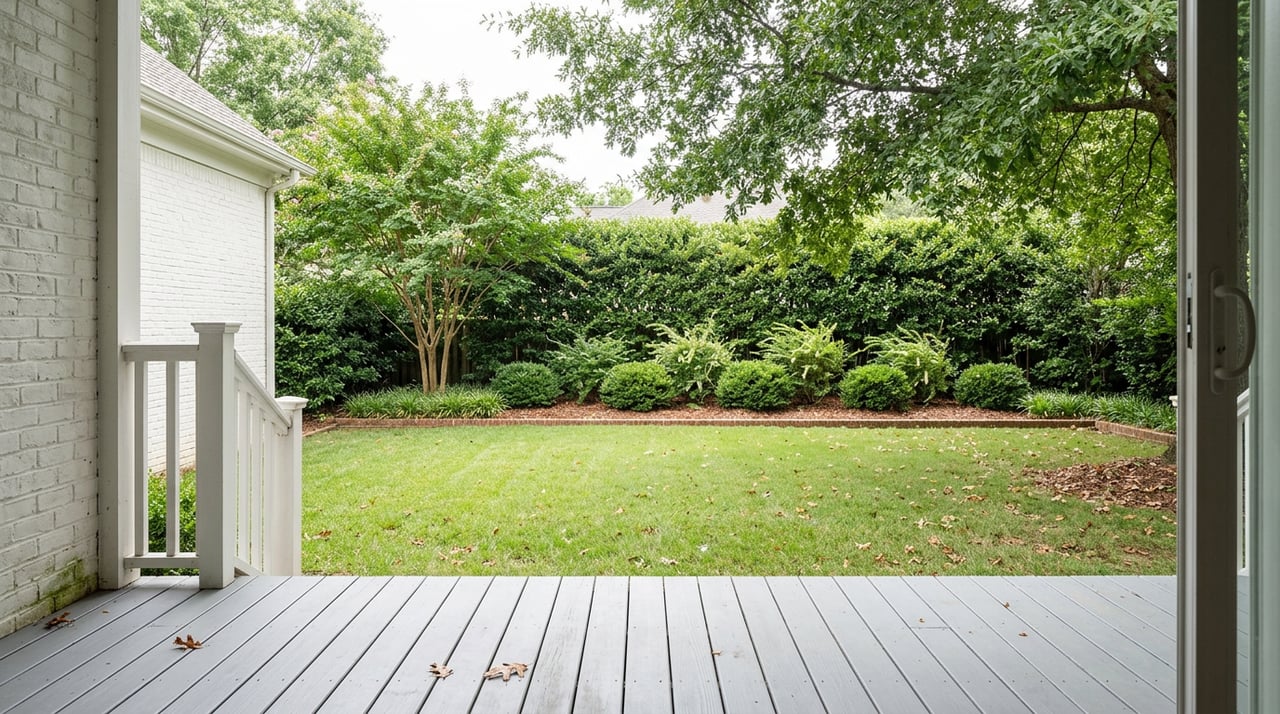
Dunwoody Tree Ordinance Renovation Rules to Know
Search "Dunwoody tree removal permit" and you'll land on the same conclusion five different times: All In Tree Services and Pro says single-family homeowners outside the city's protected stream buffers don't need a permit to take down a tree on their own lot. Tree services list it as a selling point. General contractors mention it in passing before moving on to setbacks and impervious surface limits. It's accurate, as far as it goes.
It doesn't go far enough for anyone planning an addition, a pool, or a teardown-rebuild on one of Dunwoody's older, heavily wooded lots. The city's tree preservation code does something the permit question never addresses: it sets a minimum tree density that a single-family lot has to maintain after the clearing is done. Skip that step and the cost shows up later, after the excavator has already left, in the form of a replanting requirement nobody budgeted for.
Dunwoody's tree standards live in Chapter 16, Division 6 of the city code, administered by the Community Development Department alongside City Arborist Amanda Corr. For a single-family lot sitting outside the city's protected stream buffers, the rule is exactly what the contractor sites say: no permit is required to remove a tree.
That's the removal question answered. It's not the same question as whether your site still meets the standard the ordinance actually cares about.
Section 16-109(b)(2) of the code sets a minimum tree density for single-family lots, calculated against the square footage of the property. If a homeowner clears more canopy than the density standard allows, without permit, the ordinance requires new trees to be planted until the site meets density again.
This is the part that turns a straightforward clearing job into a second phase of work. A homeowner who removes a stand of pines to open up a rear yard for an addition, assuming the "no permit" answer means the project is clear, can find out during design review or a later inspection that the lot now falls short of the density requirement and new trees have to go in, on top of whatever landscaping the addition already called for.
Here's how the two situations actually compare:
| Situation | Permit Required? | What Still Applies |
|---|---|---|
| Removing trees on a single-family lot outside the 75-foot stream buffer | No | Site must still meet the density standard in Sec. 16-109(b)(2); a shortfall means replanting |
| Removing trees within the 75-foot stream buffer | Yes | Requires a certified arborist's report |
The middle row is where the rule gets genuinely stricter, and it's worth understanding why.
Dunwoody's 75-foot stream buffer isn't governed by the density math above. Any tree removal inside that buffer requires a permit and a certified arborist's report. Rough Draft Atlanta reported in 2018 that a council amendment added the permit requirement and set fines of up to $1,000 per tree for unauthorized removal.
The report also quoted the City Arborist: "the city receives weekly phone calls and emails from residents" questioning or concerned about buffer removals happening nearby. That volume of complaints is what pushed the buffer rule from a soft preference into an enforced permit requirement. If your lot backs up to a creek anywhere in Dunwoody, that's the version of the ordinance to check before a single branch comes down, not the more forgiving standard-lot answer.
Dunwoody's housing stock is concentrated in the 1970s through 1990s, and the neighborhoods that carry the most mature canopy are also the ones seeing the most renovation activity. Georgetown and Dunwoody Club Forest hold traditional brick colonials and split-levels from the late 1970s and early 1980s. Wynterhall and the streets around Dunwoody Country Club sit on larger lots with brick ranches and two-story traditionals from the 1980s and 1990s. These are exactly the floorplans that feel compartmentalized against what today's buyers expect, which is why second-story additions, rear bump-outs, and kitchen reconfigurations that open a closed floorplan are common projects across these streets.
Local renovation firms working in Dunwoody put kitchen reconfigurations that remove a load-bearing wall and add custom cabinetry and stone countertops in the $80,000 to $150,000 range depending on scope. That's real money riding on a design that starts with an accurate site plan, not one that has to be reworked mid-project because the rear yard no longer meets density after clearing.
Setback requirements, impervious surface limits, and tree protection all factor into that design phase. The homeowners who avoid a second round of replanting are the ones who bring a tree count into the design conversation before a single tree comes down, not after.
Dunwoody's Perimeter Center corridor has added real demand pressure over the past two years. Infor, a business cloud software company, relocated its headquarters to Dunwoody's Campus 244 in May 2026, bringing roughly 500 employees. The High Street mixed-use development in Central Perimeter has added more than 300 residents alongside new retail. KDC's towers at Park Center, approved in 2024, are adding hotel rooms, residential units, and commercial space to the same corridor.
That kind of employment and residential growth is exactly what makes an older, well-located lot in Georgetown or Wynterhall worth the investment of a full renovation rather than a sale as-is. Dunwoody's median sale price came in at $712,000 for the three months ending in May 2026, up 5.1% from the same period a year earlier. That equity is the reason a clearing mistake matters more than it would in a slower market. A replanting requirement that adds weeks to a project timeline costs more when the carrying costs and opportunity costs are both rising with the corridor around you.
The right sequence on a wooded Dunwoody lot is a tree inventory before a demo plan, not after. A design that accounts for which trees stay and which come down, matched against the density math the ordinance actually requires, avoids the two-phase project where landscaping gets bolted on to satisfy a requirement nobody checked at the start. That's true whether you're adding a primary suite over an existing footprint or repositioning an older home for resale.
Does the density rule apply if I'm only removing one or two trees? The density standard is based on the square footage of the lot, so the answer depends on how many trees remain relative to that standard after the work, not on the count of trees removed in a single project.
I'm buying a home in Dunwoody where the seller already cleared the lot. Does this affect me? It's worth asking about tree history on any heavily reduced lot before finalizing a renovation plan.
What if my lot doesn't touch a stream at all? Then the stricter buffer rule doesn't apply to you, and the standard single-family removal rule governs. The density requirement in Sec. 16-109(b)(2) still applies regardless of whether a stream buffer is present.
If you're weighing a renovation, an addition, or a teardown-rebuild on a Dunwoody lot and want the tree math worked into the design plan from the start, Darron O'Bonnon combines two decades of design and space-planning work with local real estate representation across North Fulton and DeKalb. Schedule a design-forward market consultation to walk your lot, your floorplan, and your numbers before the first tree comes down.
This article is general information, not legal, tax or financial advice. Consult a qualified professional about your situation.
Whether you're in the research phase at the beginning of your real estate search or know exactly what you're looking for, you'll benefit from having a real estate professional.